
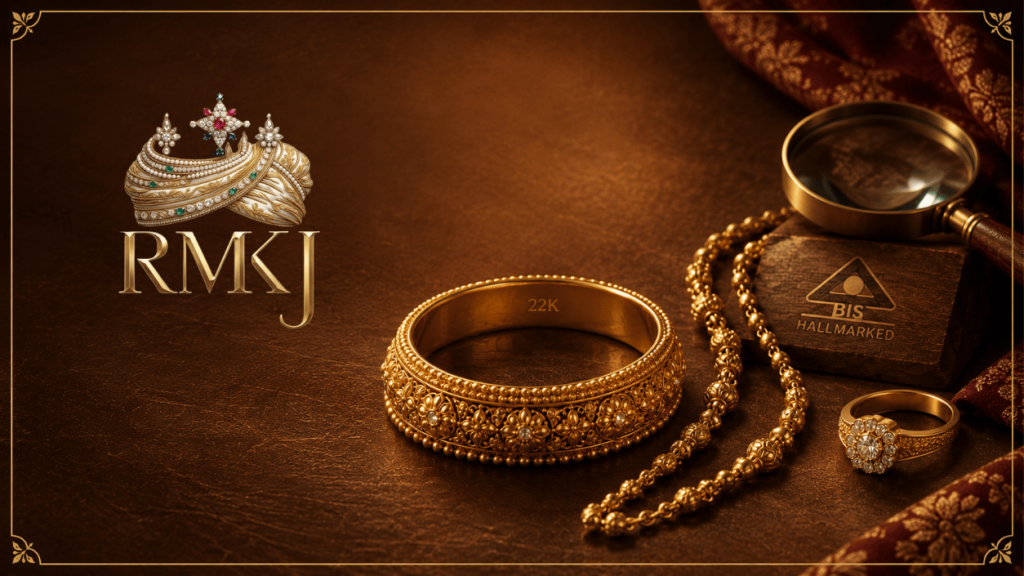
BIS Hallmark on Gold: What It Means & Why It Matters
Walk into any gold showroom today and you’ll notice something small stamped inside a ring, on the clasp of a chain, or along the inner edge of a bangle. It looks unremarkable — a tiny triangle, a few numbers, a short code. Yet that mark is the single biggest reason you can trust the gold you’re about to buy. It’s called the BIS Hallmark on Gold, and understanding what it means could save you from an expensive mistake.
For generations, buying gold in India ran on faith — faith in the jeweller’s word, faith in a family’s long-standing reputation, faith that “22 karat” actually meant 22 karat. Hallmarking replaced that faith with proof. Whether you’re purchasing a wedding set, an investment coin, or a simple gift, knowing how to read this mark puts the power of verification directly in your hands.
What Is BIS Hallmark? Understanding the Meaning
The BIS hallmark meaning starts with the Bureau of Indian Standards (BIS), the national body responsible for setting and certifying quality standards across the country. Hallmarking, in simple terms, is the official testing and certification of precious metal purity. When a piece of jewellery carries a BIS hallmark, it means that piece has been tested at a BIS-recognised Assaying and Hallmarking Centre and found to genuinely contain the percentage of gold it claims to.
Before this system existed, a buyer had almost no independent way to confirm purity. A jeweller could call a piece “22 karat,” and unless you sent it for testing yourself, you simply had to believe it. The BIS hallmark on gold changed that equation entirely — it shifted the burden of proof from the buyer’s trust to an independent, government-backed certification.
The Three Marks You’ll Find on Every Hallmarked Piece
Once a jewellery item passes testing, it doesn’t just get a vague “approved” stamp. It receives three distinct, laser-engraved marks:
- The BIS Logo — the official triangular mark of the Bureau of Indian Standards, confirming the item was tested at a recognised centre.
- The Purity Grade — a number like “22K916,” which tells you both the karat and the exact fineness of the gold.
- The HUID Code — a unique six-character alphanumeric code assigned to that specific piece and no other.
Older hallmarks also carried separate jeweller and assaying-centre symbols stamped directly onto the metal. Under the current system, those details aren’t engraved anymore — they’re stored digitally against the HUID number instead, which makes the whole process far harder to fake.
Decoding the Purity Numbers
Gold purity is expressed in two ways: karat and fineness. A BIS hallmark gold jewellery piece will typically show one of the following:
- 999 — 24 karat, 99.9% pure gold, mainly used for coins and bars
- 916 — 22 karat, 91.6% pure, the standard for most Indian wedding and traditional jewellery
- 750 — 18 karat, 75% pure, popular for diamond-studded and lightweight designer pieces
- 585 — 14 karat, 58.5% pure, valued for strength and everyday wear
- 375 — 9 karat, 37.5% pure, the newest addition to the mandatory list, aimed at more affordable jewellery
Knowing this scale helps you match your purchase to its purpose — 22K for heirloom pieces meant to last generations, 18K or 14K for daily-wear designs that need extra durability.
What Is the HUID Number, and Why It’s a Game-Changer
Of the three marks, the HUID number — short for Hallmark Unique Identification — is the one doing the real heavy lifting. Think of it as a digital fingerprint for your jewellery. No two pieces share the same code, and every HUID is linked to a central BIS database containing the item’s purity, the registered jeweller, and the assaying centre that tested it.
This is precisely why a fake hallmark is so much harder to pull off today than it used to be. Anyone can engrave a triangle-shaped logo onto a piece of metal, but they can’t fabricate a HUID that actually exists in BIS records. If you enter a fake or non-existent code into the verification system, nothing comes up — and that absence tells you everything you need to know.
Is Hallmarking Mandatory in India?
Yes — and the coverage has been expanding steadily. Gold hallmarking became compulsory in a phased rollout starting in June 2021, and successive phases have brought hundreds of districts across the country under the mandatory rule. The 9-karat purity grade was added to the mandatory list in mid-2025, reflecting how popular lighter, more affordable gold jewellery has become.
A few categories remain exempt from mandatory hallmarking, including traditional Kundan, Polki, and Jadau jewellery, items weighing under 2 grams, and pieces intended for export or bullion trading. Outside these exceptions, any jeweller operating in a notified district is required to sell only hallmarked gold jewellery.
How to Verify a BIS Hallmark Yourself
You don’t need any technical expertise to check authenticity — just your smartphone. Here’s the simple process:
- Download the official BIS CARE App from the Play Store or App Store.
- Register with your mobile number.
- Locate the six-character HUID code on your jewellery (a small magnifying glass helps).
- Open the app, select the verification option, and enter the code.
- The app instantly displays the item’s purity, jeweller details, and hallmarking centre.
It takes less than a minute, and it removes all guesswork from the transaction.
Why It Matters for You as a Buyer
Beyond peace of mind, the BIS hallmark on gold carries real financial weight. Hallmarked jewellery is more readily accepted for resale, exchange, and gold loans, since its purity is already verified and documented. If a hallmarked item is ever found to fall short of its declared purity, BIS regulations entitle the buyer to compensation calculated on that shortfall — a protection that simply didn’t exist in the pre-hallmarking era.
For jewellers, the stakes are just as high. Selling non-hallmarked gold in a mandatory district can invite significant penalties, making certification not just a consumer safeguard but a business obligation. This shared accountability — between the regulator, the jeweller, and the buyer — is what keeps the entire market honest.
There’s also a long-term angle worth considering. Gold is rarely bought for a single occasion; it’s passed down, gifted, exchanged, or converted into new designs over the years. A hallmarked piece keeps its documented purity intact through all of that, which means your children or grandchildren won’t need to re-test a family heirloom to know exactly what it’s worth. In a market where gold prices fluctuate constantly, that kind of certainty is invaluable.
Common Myths About BIS Hallmarking
A lot of confusion still surrounds hallmarking, so it’s worth clearing up a few misconceptions:
- “An old stamp without a HUID means the jewellery is fake.” Not necessarily — older hallmarked pieces bought before the HUID system was introduced remain valid for life. They simply predate the current digital-tracking format.
- “Hallmarking is only for expensive, heavy jewellery.” In reality, the rules apply across karat ranges, including lighter 14K and 9K pieces meant for everyday wear.
- “Once hallmarked, a piece never needs to be checked again.” True — the hallmark is valid for the lifetime of the jewellery, but it’s still smart to verify the HUID at the time of purchase, especially with resale or exchanged items.
- “Silver jewellery must also carry a hallmark.” Silver hallmarking remains voluntary in India, though any silver piece that is hallmarked must still carry a valid HUID code.
Why Trust Matters When You Choose Your Jeweller
A hallmark tells you the metal is genuine — but the relationship you build with your jeweller determines everything else: the craftsmanship, the design guidance, and the honesty of every transaction thereafter. This is exactly why generations of families across Punjab continue to return to trusted, established jewellers in Ludhiana for their gold — heritage names that have built their reputation not on a single stamp, but on decades of transparent dealing.
At Ram Murti Kewal Krishan Jewellers, every piece that leaves our showroom carries full BIS hallmark certification, so you never have to choose between beautiful craftsmanship and verified purity. The next time you’re shopping for gold, don’t just admire the design — check the hallmark, verify the HUID, and buy with complete confidence.
Gold has always been more than an ornament in Indian households; it’s a store of trust passed from one generation to the next. The BIS hallmark simply makes sure that trust is backed by proof, every single time.